
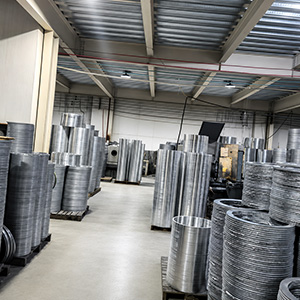
Most turntable projects start from a size list and end with a drawing that does not fit it. A designer needs a 520 mm ring with a non-standard centre bore and a rebate for a flush fit; a furniture brand wants its own bolt pattern so its tops cannot be substituted; a distributor needs packaging that survives a long sea leg without crushing the ring. All three are normal requests, and all three are solved the same way — with tooling developed for the job.
When a Custom Turntable Makes Sense
Standard size steps cover the large majority of household and commercial tables. Custom development is the right answer when one of these applies:
| Situation | Why standard sizing fails |
|---|---|
| Table diameter falls between standard steps | Correct ratio cannot be reached without an odd diameter |
| Centre bore intersects a support column | Bore size and concentricity are fixed by the structure |
| Flush or recessed mounting required | Needs a rebate machined to the top's thickness |
| Proprietary fixing pattern | Existing bolt circles do not match the top's frame |
| Higher load than the standard rating | Ring section and track must be strengthened |
| Brand-specific packaging or labelling | Retail and export requirements differ per market |
The Development Process, Step by Step
We have run this sequence since 2000, and the order is deliberate — each step removes risk before money is committed to the next.
1. Requirement analysis. Before any drawing, we confirm the turntable diameter and tabletop interface, the structural load requirement, the usage scenario (household, restaurant, banquet, project), the expected order quantity, and any packaging or branding constraints. Getting the load case right here prevents a ring that is dimensionally correct but structurally marginal.
2. Mold development. Independent mold development is the capability that makes the rest possible. Tooling is designed for the specific diameter, section and mounting features, so the resulting part is produced to the project's geometry rather than adapted from the nearest standard size. This is also where the decision is made between reusing an existing mold family and cutting new tooling — a volume-sensitive trade-off worth discussing early.
3. Material processing. Parts are formed from quality aluminium alloy using standardized procedures. Aluminium is chosen for the combination that matters in a rotating furniture component: low weight, corrosion and wear resistance, and enough stiffness in a thickened section to hold the running track flat.
4. Assembly and testing. Completed units are checked for rotation smoothness, structural stability, quiet performance and appearance. Rotation is assessed as an assembly — ring, elements and track together — because that is how the customer experiences it.
5. Packing and delivery. Finished goods are packed to suit the destination and handling profile, supporting both domestic and overseas shipment. For export orders this is where protection against crushing and surface marking is designed in, not added afterwards.
What to Send Us for a Quotation
The more of the following you can supply, the faster the quotation and the lower the risk of a mismatch:
- Diameter and tolerance, with a note on whether standard steps were considered.
- Tabletop interface drawing — thickness, material, and whether the core is solid or hollow.
- Load case — expected static and dynamic load, and the usage scenario.
- Centre bore size and whether it must clear a column or carry wiring.
- Mounting method — screw pattern, adhesive, or recessed fit, with the required bolt circle if proprietary.
- Surface and colour requirement, including whether a polished or brushed finish is acceptable.
- Order quantity and expected repeat volume, which determines whether dedicated tooling is economic.
- Packaging and branding requirements, plus destination market.
Quality Control Across the Order
Custom work raises the stakes on consistency: a one-off sample that fits is not the same thing as a shipment of two thousand identical rings. Our inspection system monitors each production stage and inspects finished products before shipment, which is how a custom dimension stays a custom dimension across repeat orders. Incoming material, in-process dimensions, assembly rotation checks and outgoing packing are all covered.
For buyers, this translates into a practical benefit: fewer after-sales claims caused by dimensional drift, and a stable product the end customer sees consistently regardless of which batch their table came from.
Where to Go Next
To see the factory and process behind the tooling, browse the factory blog and the workshop production line walkthrough. The upgraded high-end unit that most custom projects are based on is listed on the patented noise-reduction turntable page.
Before specifying, it is worth settling the load case — see the sizing and load capacity guide — and deciding whether the mechanism needs the upgraded silent structure, covered in the bearing and noise guide.
